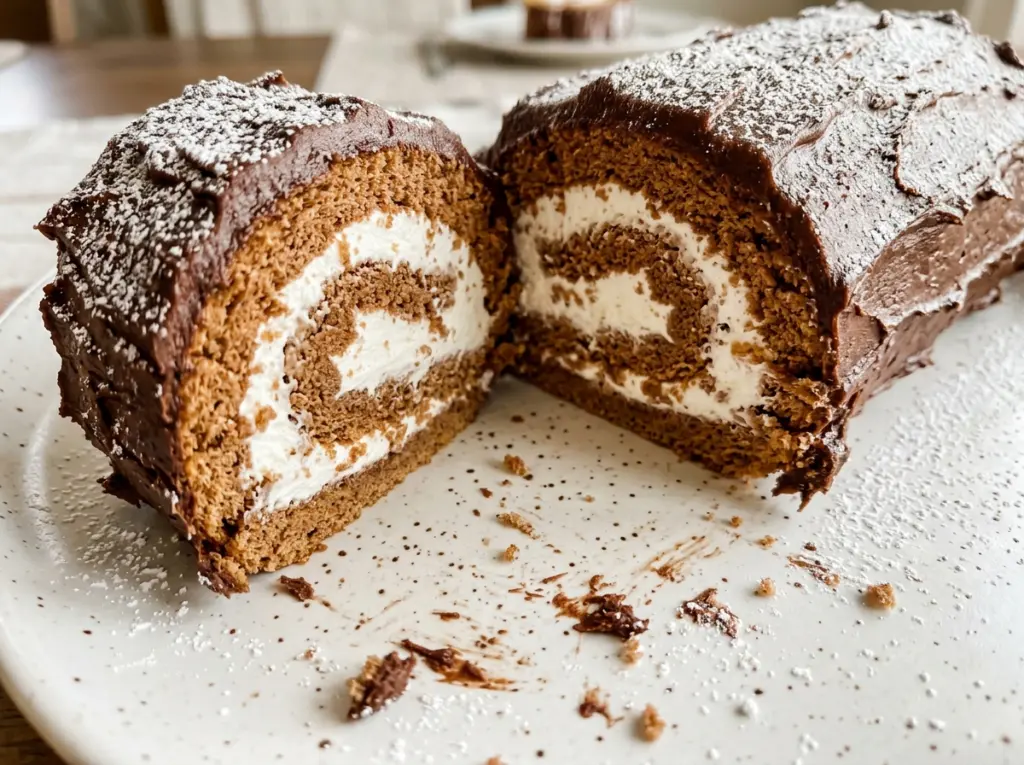
The sponge gives a little spring when you tap the center, but it still feels delicate as it comes from the oven. That’s exactly what you want for a rolled cake: a thin chocolate layer that bends while it’s warm, then holds its shape around a soft cream filling. This Christmas Yule Log Sheet Cake gets its log shape from rolling the sponge with parchment inside, not from a special mold or complicated decorating.
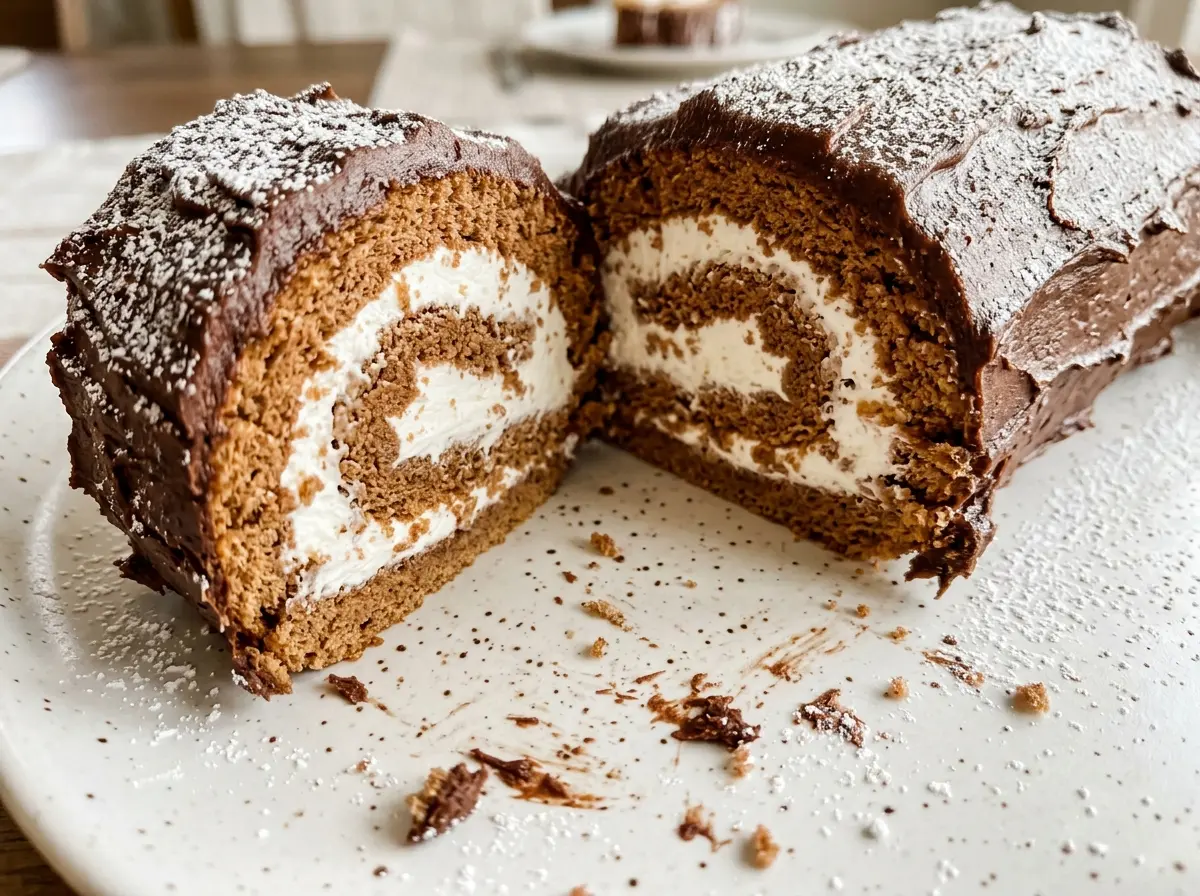
I roll the cake as soon as it’s inverted, while it’s still pliable, and let it cool completely in that shape. Once it’s cool, the sponge has a gentle curve ready for the whipped cream, so it doesn’t have to go from flat to tightly rolled all at once. Semisweet chocolate frosting covers the outside, and a fork dragged through it gives the cake its bark-like finish. Each slice shows a chocolate spiral wrapped around cream.
Kitchen Note
Stop beating the cream when it holds firm peaks. You want it sturdy enough to spread, but still smooth; if it starts looking grainy, it’s gone past the texture this filling needs.
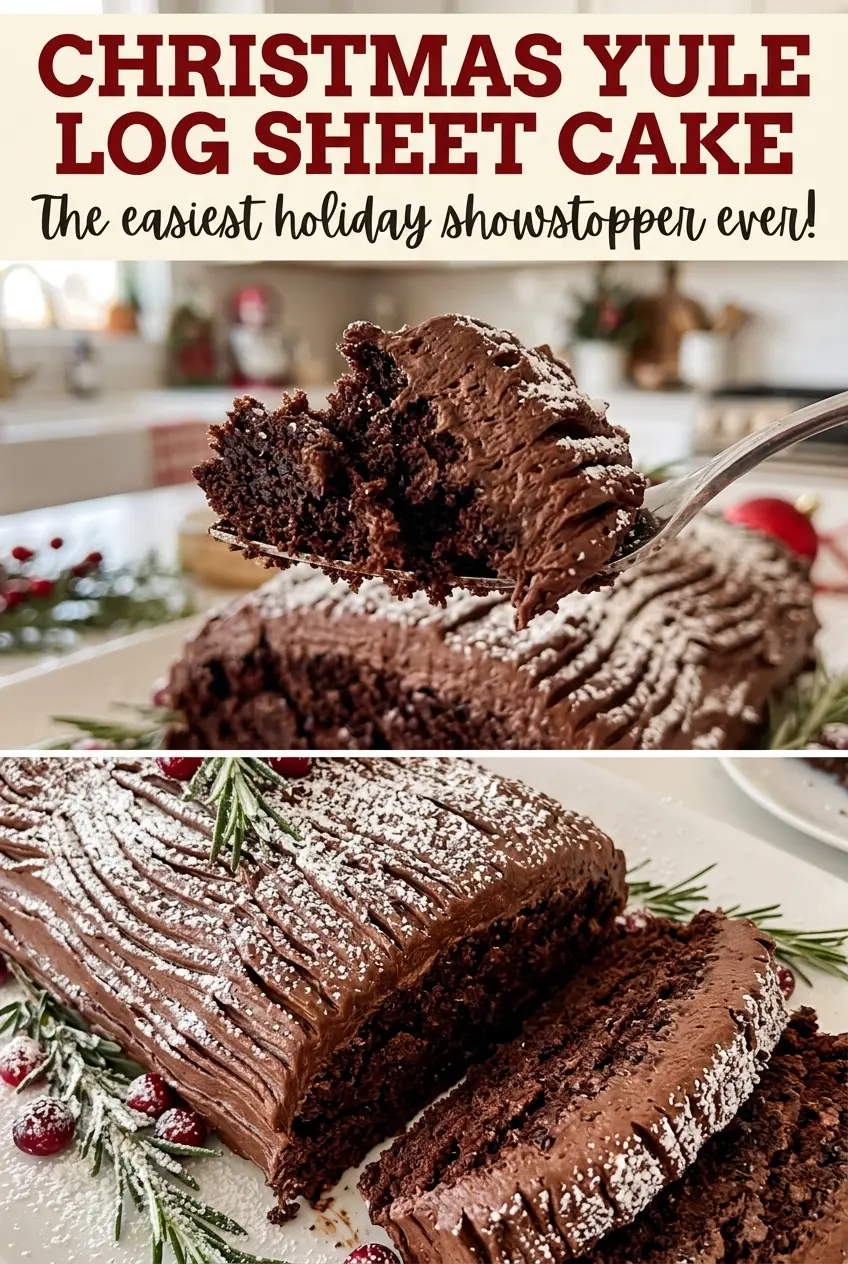
Save this Christmas Yule Log Sheet Cake for a chocolate sponge, whipped cream center, and forked bark finish that looks special without a shaped pan.
Why the Egg Whites Matter More Than the Baking Powder
This cake is a sponge, not a butter cake cut into a thin layer. It doesn’t rely on creamed butter to build its structure; much of its lift comes from air beaten into the egg whites. Baking powder helps, but the whipped whites are what give the batter enough lightness to bake into a flexible sheet rather than a dense slab.
That’s also why the folding stage deserves a gentle hand. The yolk mixture starts thick, and the whites add volume without making the batter heavy. Folding in a portion first loosens the yolks, so the rest of the whites can be incorporated with fewer strokes. A few careful folds preserve more of that air than vigorous stirring, which matters in a cake that needs to bend around a filling. The finished sponge is tender and light, with enough structure to hold the cream once it’s rolled.
What the Cocoa, Chocolate, and Sugars Each Do in This Yule Log
- Unsweetened cocoa powder — It gives the sponge its chocolate flavor without adding the moisture that melted chocolate would bring to this thin batter. Use cocoa that smells rich and fresh; stale cocoa tastes flat here. The recipe uses it alongside semisweet chocolate, not as a replacement for it.
- Eggs — Separating the yolks and whites gives the batter both richness and lift. Room-temperature eggs beat more easily into the thick yolk mixture and the airy whites. Keep the bowl for the whites clean so they can form glossy peaks.
- Granulated and confectioners’ sugar — Granulated sugar sweetens the sponge and helps stabilize the whipped whites as it’s beaten in. Confectioners’ sugar dissolves smoothly into the cream and frosting; granulated sugar won’t give either one the same fine texture.
- Heavy cream — This is what makes the soft, airy filling. It needs enough fat to whip into firm peaks, so lighter cream won’t give the same filling or hold its shape as well inside the roll.
- Semisweet chocolate — Finely chopping it helps it melt evenly in short microwave intervals. The cocoa powder in the cake can’t stand in for this chocolate in the frosting; the melted chocolate gives the frosting its smooth, spreadable body.
- Salted butter — Softened butter blends smoothly with the confectioners’ sugar and milk. If it’s cold, the frosting can stay lumpy; if it’s melted, the frosting won’t have the same spreadable texture.
- All-purpose flour and baking powder — Together, they give the sponge enough structure to roll while keeping it light. Stick with the all-purpose flour in this formula; a different flour or self-rising flour changes the balance of the thin cake.
How to Roll, Fill, and Frost the Sponge Without Losing Its Shape
Build the yolk base and whip the whites
Heat the oven to 350°F, then grease a 10×15-inch jelly-roll pan, line it with parchment, and lightly grease the parchment. Whisk the flour, cocoa powder, baking powder, and salt in a medium bowl. Beat the yolks with 1/2 cup of the granulated sugar and the vanilla on medium-high until pale and thick, about 3 to 4 minutes, then mix in the dry ingredients until no dry streaks remain. In a clean bowl, beat the whites to soft peaks, gradually add the remaining 1/4 cup sugar, and continue until the peaks are stiff and glossy.
Fold gently and bake the thin cake
Fold one-third of the whites into the yolk mixture to lighten it, then gently fold in the rest just until no white streaks remain. Scrape the batter into the prepared pan and spread it evenly into the corners. Bake for 10 to 12 minutes, until the top springs back when lightly touched; an overbaked sponge is more likely to crack when rolled. Loosen the edges as soon as the pan comes out of the oven.
Roll the cake while it’s warm
Set a fresh sheet of parchment over the cake and invert it onto the parchment. Carefully peel away the parchment that lined the pan, then start at a short end and roll the cake up with the fresh parchment inside. Set it seam-side down and leave it rolled until completely cool, about 1 hour. Don’t try to fill it while warm; the cream needs a cool sponge, and the roll needs time to hold its shape.
Fill, reroll, and chill
Beat the heavy cream with 1/4 cup of the confectioners’ sugar until firm peaks form. Carefully unroll the cooled cake and remove the parchment, then spread the cream evenly over the sponge, leaving a 1/2-inch border around the edges. Reroll the cake without the parchment and place it seam-side down on a serving platter. Refrigerate it for 30 minutes before frosting so the filled roll is easier to coat.
Make the chocolate bark finish
Melt the finely chopped semisweet chocolate in a microwave-safe bowl in 20-second intervals, stirring between each interval. Let it cool until fluid but no longer hot, about 10 minutes; hot chocolate can make the butter mixture too soft. Beat the softened butter with the remaining 1 1/4 cups confectioners’ sugar and the milk until smooth, then beat in the melted chocolate until the frosting is spreadable. Coat the chilled cake, drag a fork lengthwise through the frosting for bark-like lines, and refrigerate for 20 minutes to set it.
Three Ways to Change the Look Without Changing the Chocolate-and-Cream Filling
Give the log a small branch
After the filled roll has chilled, cut a short diagonal piece from one end and set it against the side of the main log. Use some of the chocolate frosting to hold it in place, then frost the whole cake and drag the fork marks across both pieces. The extra branch gives the cake a classic Yule log silhouette, though the sides take a little more care to frost.
Make the bark marks wavy
Instead of dragging the fork in straight lines, move it in loose, shallow waves along the length of the frosted roll. Keep the strokes light so you texture the frosting without pulling it away from the cake. The finish looks more rustic and irregular, while the chocolate coating stays the same.
Serve it as chocolate pinwheels
Slice the chilled cake into rounds and arrange them with the cream spiral facing up. This changes the presentation from one centerpiece log to individual portions, and each slice shows off the filling. Keep the slices thick enough to hold together when lifted.
Keeping and Serving the Cream-Filled Cake
- Refrigerator: Keep the cake covered and chilled; the whipped cream filling is at its best within 3 days, though the sponge gradually softens.
- Freezer: I don’t recommend freezing the assembled log. The whipped cream can lose its smooth texture as it thaws.
- Serving: Serve it cold from the refrigerator. It doesn’t need reheating, and the chilled filling helps the slices keep their spiral shape.
Questions That Come Up When Making a Rolled Yule Log
Christmas Yule Log Sheet Cake
Ingredients
Equipment
Method
- Preheat the oven to 350°F.
- Grease a 10x15-inch jelly-roll pan.
- Line the pan with parchment paper and lightly grease the parchment.
- Whisk the flour, cocoa powder, baking powder, and salt in a medium bowl.
- Beat the egg yolks with 1/2 cup of the granulated sugar and the vanilla on medium-high speed until pale and thick, 3 to 4 minutes.
- Mix the dry ingredients into the yolk mixture until no dry streaks remain.
- In a clean bowl, beat the egg whites on medium-high speed until soft peaks form.
- Gradually beat in the remaining 1/4 cup granulated sugar and continue until stiff, glossy peaks form.
- Fold one-third of the egg whites into the yolk mixture to lighten it.
- Gently fold in the rest of the egg whites until no white streaks remain.
- Spread the batter evenly in the prepared pan.
- Bake for 10 to 12 minutes, until the top springs back when lightly touched.
- Immediately loosen the cake edges and invert it onto a fresh sheet of parchment.
- Carefully peel off the parchment from the pan.
- Starting at a short end, roll the cake up with the fresh parchment inside.
- Set the rolled cake seam-side down to cool completely, about 1 hour.
- Beat the heavy cream with 1/4 cup of the confectioners' sugar until firm peaks form.
- Carefully unroll the cooled cake and remove the parchment.
- Spread the whipped cream evenly over the cake, leaving a 1/2-inch border.
- Reroll the cake without the parchment.
- Place it seam-side down on a serving platter and refrigerate for 30 minutes.
- Melt the chocolate in a microwave-safe bowl in 20-second intervals, stirring between each.
- Let the melted chocolate cool until fluid but no longer hot, about 10 minutes.
- Beat the softened butter with the remaining 1 1/4 cups confectioners' sugar and the milk until smooth.
- Beat in the melted chocolate until the frosting is smooth and spreadable.
- Spread the frosting over the chilled cake.
- Drag a fork through the frosting lengthwise to make bark-like lines.
- Refrigerate for 20 minutes to set the frosting before serving.