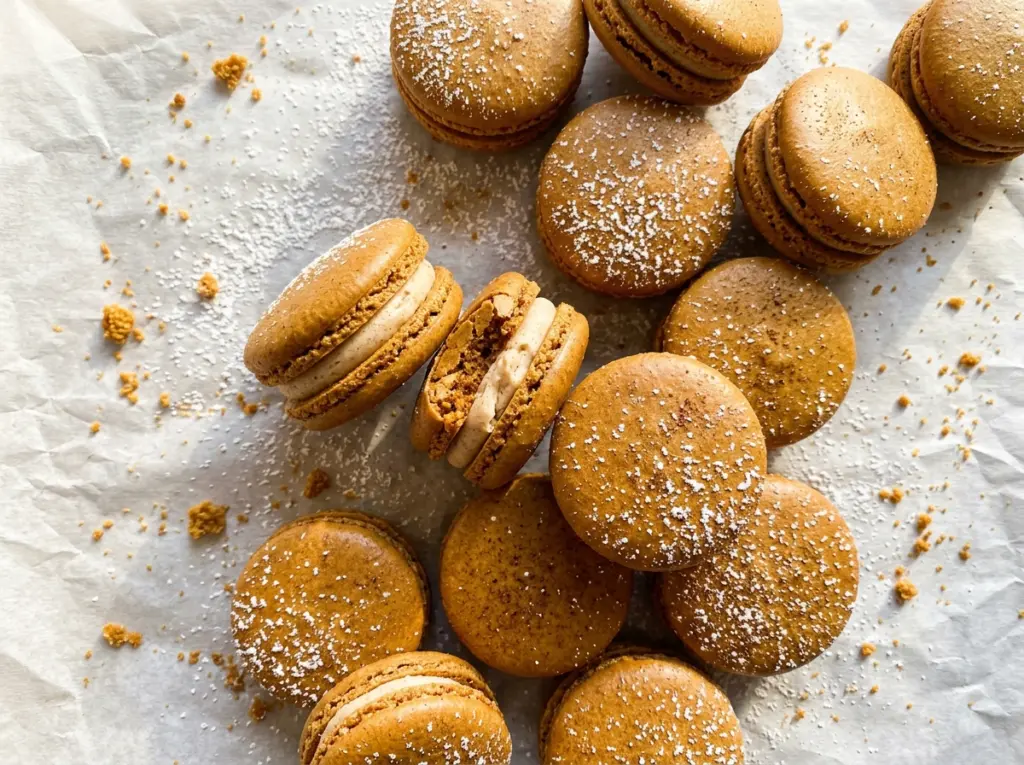
The batter tells you a lot before a macaron ever reaches the oven. If it drops from the spatula in a steady, thick ribbon and slowly settles back into itself, you’re close; if it pours, the shells can spread before they set. I watch that moment especially closely when I make these gingerbread macarons, because the ground spices make the batter look a little different from a plain macaron.
Macarons reward a light touch, but stopping too early leaves a stiff batter that pipes with peaks. I fold in the dry ingredients in three additions, then check how quickly the ribbon sinks back into the bowl. After piping, the shells need to stand until their tops feel dry rather than tacky. That patient pause gives you neat, spiced shells ready for a smooth white chocolate and molasses ganache.
Kitchen Note
Let the shells cool completely on the parchment before you try to lift them. Warm macarons are delicate, and peeling them early can leave the bottoms behind.
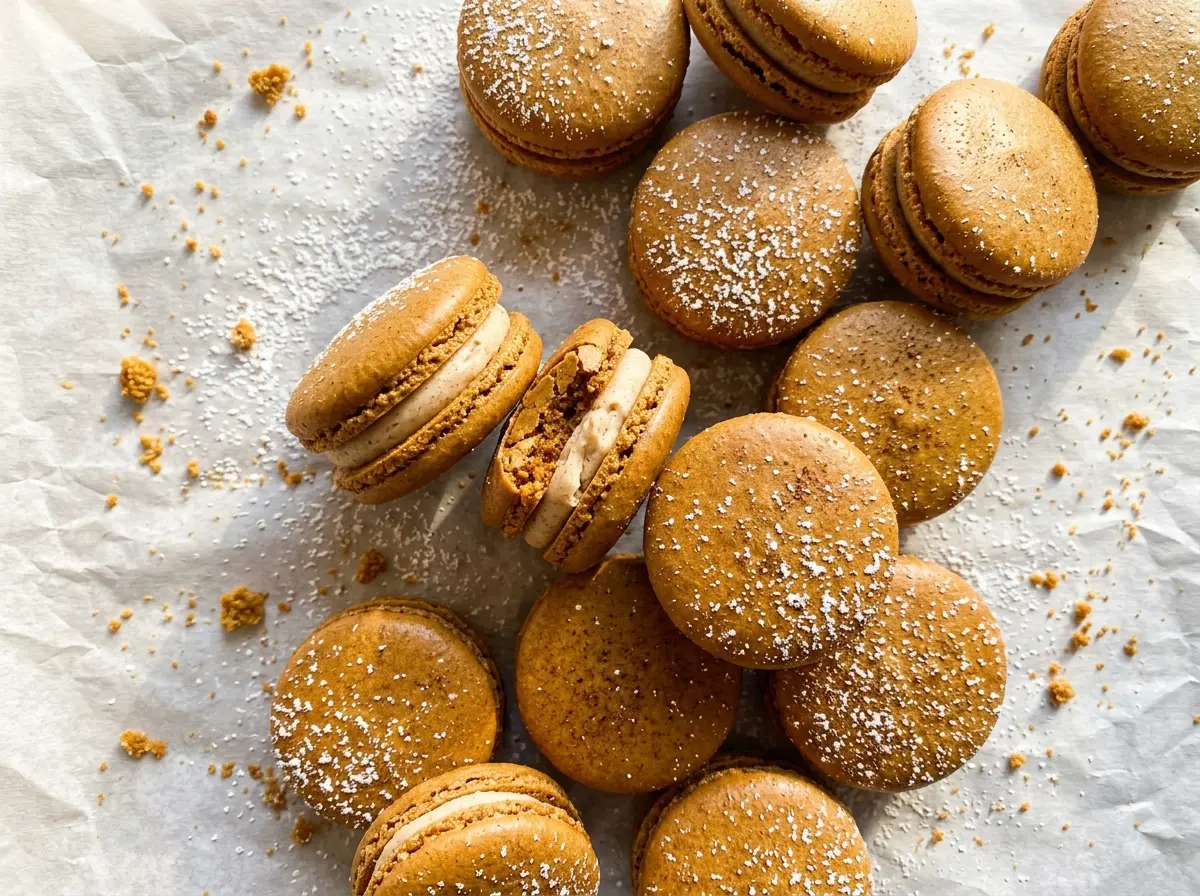
Save these gingerbread macarons for their warm spice, crisp shells, and creamy molasses ganache.
Why the Macaron Batter Should Fall in a Ribbon, Not Pour
Macaronage—the folding that brings the meringue and dry mixture together—is where the shell texture is set. Fold too little and the batter holds stiff peaks; the piped rounds can keep those peaks instead of settling smooth. Fold too much and the batter runs thin, spreads on the parchment, and loses the structure it needs in the oven.
I don’t count folds because the mixture changes at a different pace depending on how it was combined. Instead, lift the spatula and watch the batter fall. You’re looking for a thick ribbon that sinks back into the bowl in about 10 to 15 seconds. If it disappears instantly, keep a close eye on each gentle fold; once the batter is loose, you can’t fold the structure back in. This visual cue is more useful than chasing an exact number of turns.
That same measured approach matters when you add the dry ingredients. Three additions help you fold evenly without knocking all the air out of the meringue at once. Stop when the ribbon test is right, even if a few folds remain in your head.
Why the Flour, Spices, and Chocolate Need the Right Texture

- Blanched almond flour — Its fine, pale grind gives the shells their familiar delicate texture. A coarse almond meal won’t sift as smoothly, so pulse and sift the flour mixture until the larger bits are gone. Weigh it rather than relying on a volume measure; the dry-to-meringue balance matters here.
- Confectioners’ sugar and granulated sugar — Confectioners’ sugar blends into the almond flour, while granulated sugar supports the egg-white meringue as it whips. Both have specific jobs, so I wouldn’t swap one for the other or use a cup measure in place of the stated weights.
- Ginger, cinnamon, and cloves — Together, these give the shells their gingerbread character without adding moisture. Ground spices that smell fragrant when you open the container will give a clearer aroma; stale spices will taste muted. Sifting them with the dry ingredients helps distribute them instead of leaving pockets in the batter.
- Egg whites — Room-temperature whites whip more readily than cold ones. The bowl and beaters need to be clean and dry; a trace of grease or water can make it harder to build a stable, glossy meringue. There isn’t a simple flour-style substitute for egg whites in this method.
- White chocolate, heavy cream, and unsulphured molasses — Finely chopped white chocolate melts evenly when the steaming cream is poured over it. Choose chocolate you like the taste of, since it makes up most of the filling. Unsulphured molasses adds the deep gingerbread note; a different sweetener won’t bring the same flavor, and changing the cream or chocolate can alter how firmly the ganache sets.
From Smooth Batter to a Pipeable Gingerbread Ganache
Make the spice mixture fine and even
Heat the oven to 300°F and line two 12×17-inch baking sheets with parchment. Pulse the almond flour, confectioners’ sugar, ginger, cinnamon, and cloves in a food processor, then sift the mixture into a bowl. Pulse and sift any coarse bits again; those larger pieces can keep the finished shells from having a smooth surface.
Whip the whites, then fold with care
Beat the room-temperature egg whites in a clean, dry bowl on medium speed until foamy. Gradually add the granulated sugar, then beat on medium-high until the meringue forms stiff, glossy peaks. Fold the dry mixture in three additions, watching for a thick ribbon that sinks back into the batter in about 10 to 15 seconds. If it still sits in a mound, continue with gentle folds rather than stirring briskly.
Pipe, tap, and wait for dry tops
Transfer the batter to a piping bag fitted with a 1/2-inch round tip and pipe 1 1/2-inch rounds about 1 inch apart. Tap each sheet firmly on the counter to release air pockets, then pop visible bubbles with a toothpick. Let the rounds stand for 30 to 60 minutes, until their tops feel dry and are no longer tacky. A tacky surface hasn’t reached the cue you’re looking for, so give it more time within that range.
Bake one sheet at a time
Bake each sheet at 300°F for 14 to 16 minutes, one at a time, rotating the sheet halfway through. The tops should be set and shouldn’t shift when you touch one gently. If they still move, they need more time in the oven. Cool the shells on the baking sheets for about 20 minutes before peeling them carefully from the parchment.
Stir the ganache smooth and sandwich
Put the finely chopped white chocolate in a heatproof bowl. Heat the heavy cream in a small saucepan until steaming, with small bubbles at the edge, then pour it over the chocolate and leave it for 2 minutes. Stir until smooth, add the molasses, and refrigerate the ganache for 20 to 30 minutes, stirring every 10 minutes, until it’s thick enough to pipe. Pair shells by size, pipe about 1 teaspoon of ganache onto the flat side of half, and sandwich with the remaining shells. Refrigerate the assembled macarons in an airtight container for at least 12 hours, then bring them to room temperature for about 20 minutes before serving.
Two Spice Adjustments That Keep the Macarons Gingerbread-Like
A gentler clove note
For a softer, less sharp spice finish, leave the ground cloves out and keep the ginger and cinnamon. The shells will still read as gingerbread, but the clove won’t linger as strongly. This is a flavor adjustment, not a change to the base version.
A cinnamon-light batch
Leave out the cinnamon if you want the ginger and clove to come forward more clearly. The dry mixture still needs to be pulsed and sifted with the almond flour and confectioners’ sugar, and the folding cues stay the same. This recipe uses almond flour, so it contains no wheat flour; for a dairy-free batch, the white chocolate and cream would need a separately tested replacement.
Storage and Reheating
- Refrigerator: Keep the assembled macarons in an airtight container. The shells soften as they rest with the ganache, which is part of their texture after chilling.
- Freezer: I don’t include a freezing method for this batch; the tested approach is to refrigerate the filled macarons.
- Reheating: Don’t heat them. Let them sit at room temperature for about 20 minutes before serving; microwaving can soften the ganache unevenly.
Questions That Come Up While Making Gingerbread Macarons
Gingerbread Macarons
Ingredients
Equipment
Method
- Heat the oven to 300°F.
- Line two 12x17-inch baking sheets with parchment paper.
- Pulse the almond flour, confectioners' sugar, ginger, cinnamon, and cloves in a food processor until fine.
- Sift the dry mixture into a bowl, then pulse and sift any coarse bits again.
- Beat the egg whites in a clean, dry bowl with an electric mixer on medium speed until foamy.
- Gradually add the granulated sugar and beat on medium-high until stiff, glossy peaks form.
- Fold the dry mixture into the meringue in three additions until the batter falls in a thick ribbon and the ribbon sinks back in about 10 to 15 seconds.
- Transfer the batter to a piping bag fitted with a 1/2-inch round tip.
- Pipe 1 1/2-inch rounds about 1 inch apart on the prepared sheets.
- Tap each sheet firmly on the counter and pop visible bubbles with a toothpick.
- Let the shells stand for 30 to 60 minutes, until their tops feel dry and are no longer tacky.
- Bake the sheets one at a time at 300°F for 14 to 16 minutes, until the tops are set and do not shift when gently touched.
- Rotate each sheet halfway through baking.
- Cool the shells completely on the sheets, about 20 minutes.
- Carefully peel the cooled shells off the parchment.
- Put the white chocolate in a heatproof bowl.
- Heat the heavy cream in a small saucepan until steaming with small bubbles at the edge.
- Pour the cream over the chocolate and let stand for 2 minutes.
- Stir the mixture until smooth, then stir in the molasses.
- Refrigerate for 20 to 30 minutes, stirring every 10 minutes, until thick enough to pipe.
- Pair the shells by size.
- Pipe about 1 teaspoon of ganache onto the flat side of half of the shells.
- Sandwich with the remaining shells.
- Refrigerate in an airtight container for at least 12 hours.
- Bring to room temperature for about 20 minutes before serving.