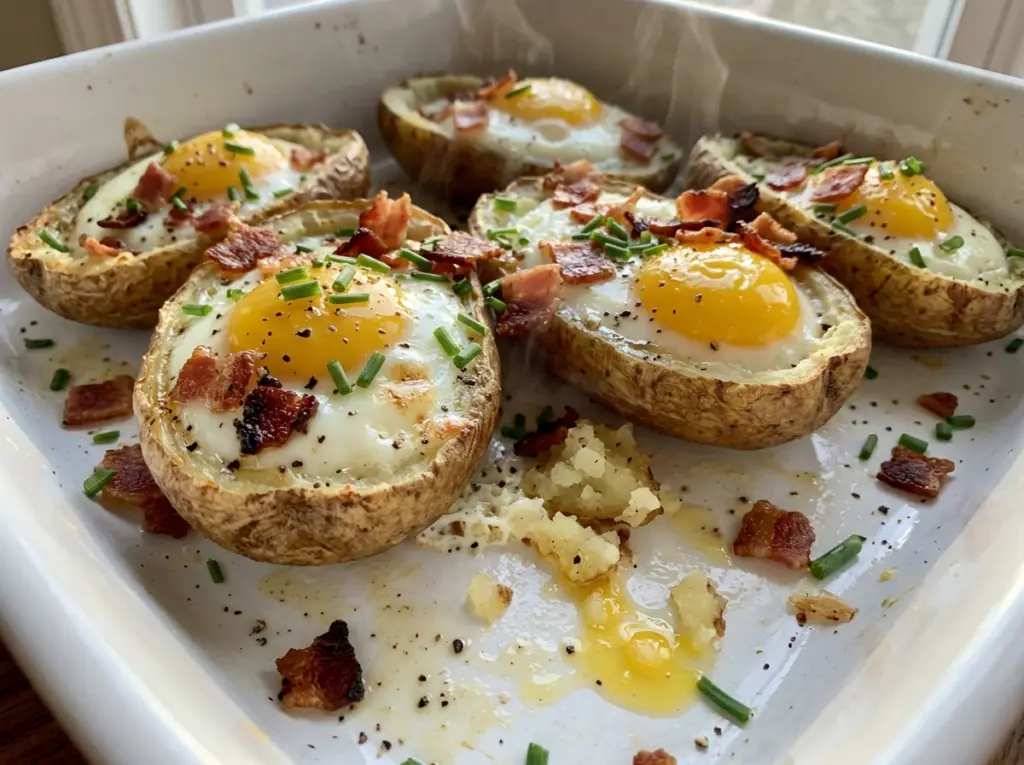
The potatoes come out of the oven with tender centers, but they still need enough structure to cradle an egg without tipping across the pan. That balance is what makes these Paleo Whole30 Egg Potato Boats work: a fully baked russet becomes a sturdy shell, and each half gets one egg for the second bake. The result is a crisp-edged potato with a set egg tucked into the middle.
I like that the potato and egg get their own time in the oven instead of asking one to cook while the other catches up. The potato softens first; after it’s hollowed and seasoned, the egg only needs to bake until its white and yolk are set. A scattering of thinly sliced scallions finishes each boat with a fresh, mild bite.
Kitchen Note
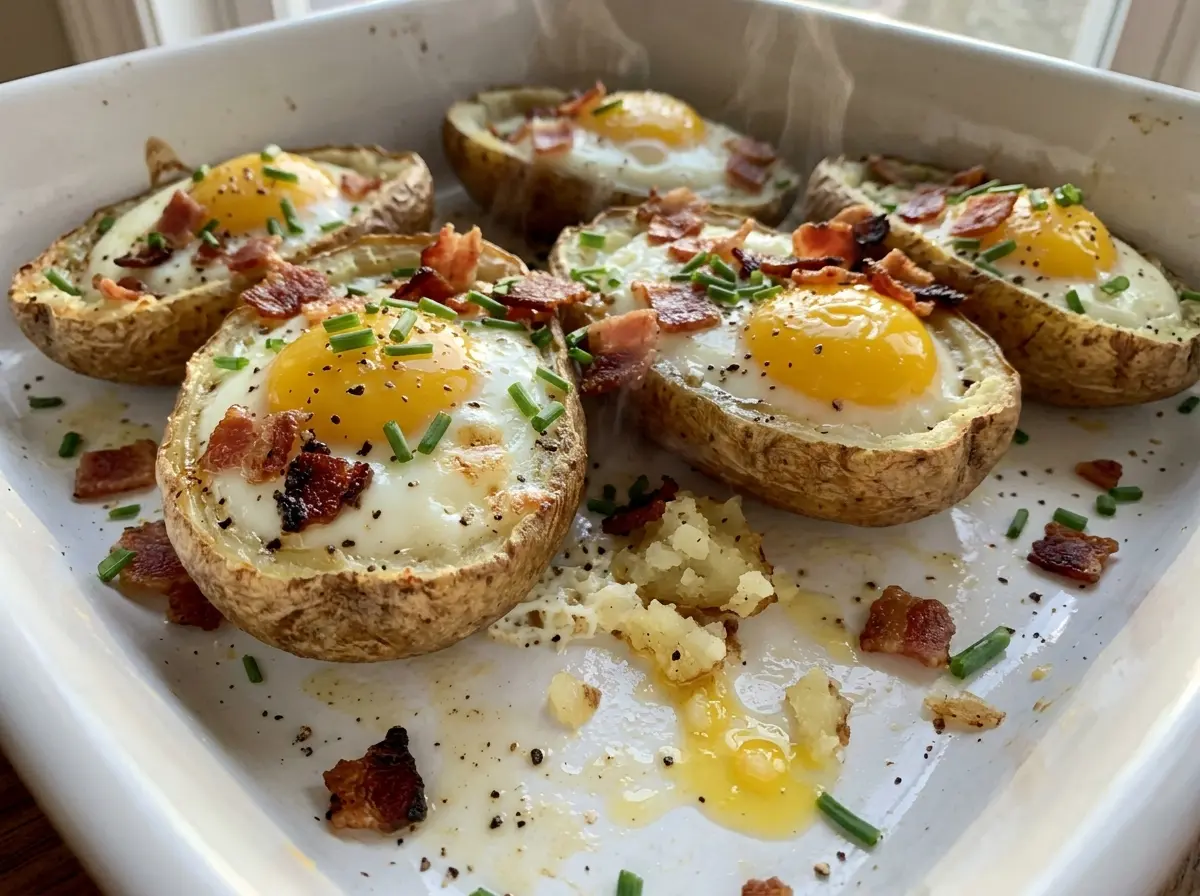
Give the potatoes the full 10-minute rest before cutting into them. They’ll still be warm, but they’re easier to handle and less likely to tear when you scoop out the centers.
Save these Paleo Whole30 Egg Potato Boats for a savory breakfast with tender potato shells and set eggs.
Why the Potato and Egg Need Separate Oven Time
A whole russet takes much longer to soften than an egg needs to set. If both went into the oven at the same time, you’d be waiting on the potato while the egg overcooked. Baking the potatoes first gives the shell time to become tender; the egg goes in only after the potato has been opened and seasoned.
That two-part bake also gives you a chance to make the cavities fit the eggs instead of guessing at the center of a raw potato. A large russet gives you two generous halves, and each half becomes its own little dish. You get a soft potato interior around the egg, with the shell holding everything together as you serve it.
These are best when each boat sits level on the baking sheet. A level shell keeps the egg centered and gives the white room to set around the yolk. The potato isn’t just a serving container; it’s the part that makes this breakfast filling and easy to pick up with a fork.
Why Russets Make the Most Reliable Egg Boats
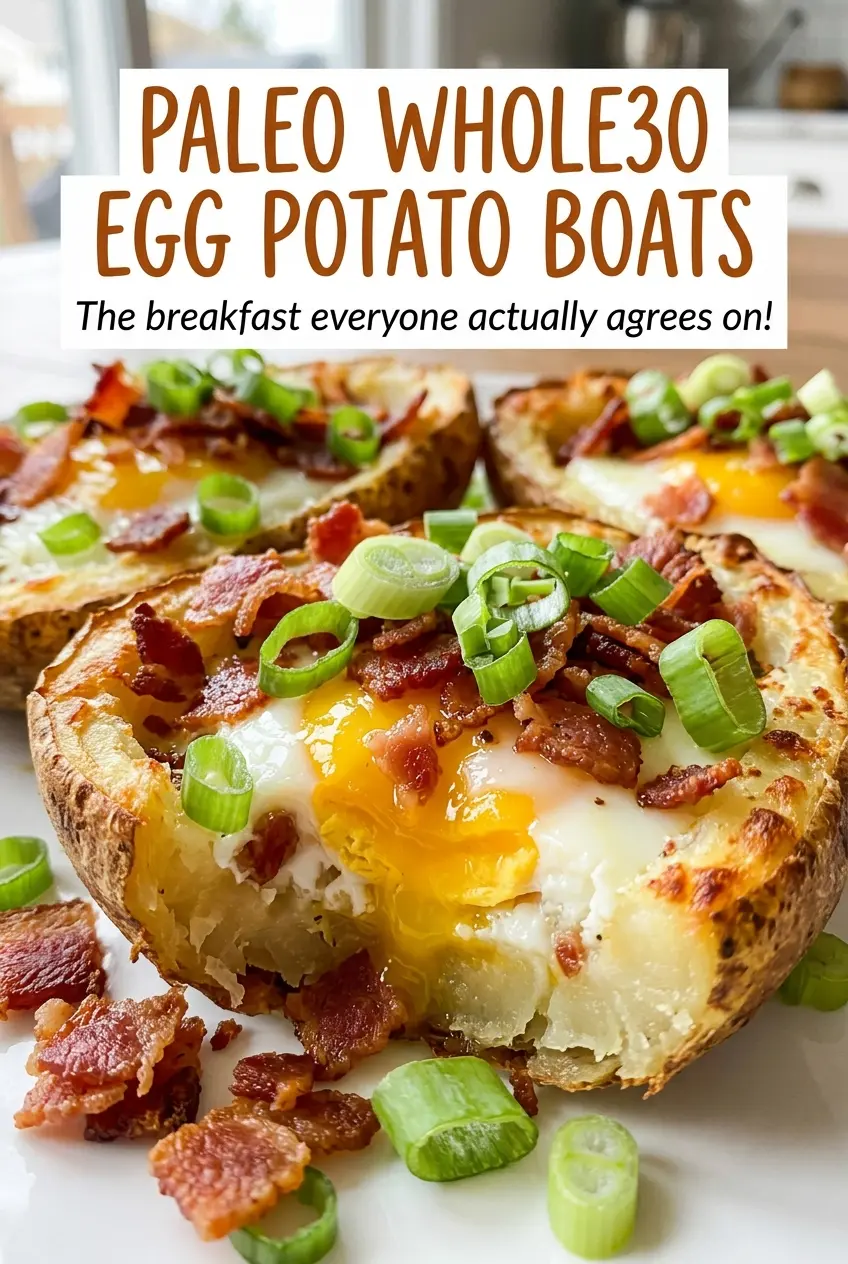
- Russet potatoes — Their large size gives each egg a roomy half, and their fluffy centers scoop out cleanly. Choose russets in the 10-to-12-ounce range so the cavities have space for a large egg. I wouldn’t substitute a smaller potato here; it can leave you with a cramped shell and a harder-to-manage egg.
- Large eggs — The size matters because each potato half holds one whole egg. Use large eggs rather than upsizing; extra-large eggs have more white to contain and may spill over the edges. Freshness matters less than using the size called for.
- Olive oil — The oil coats the potato skins and then the scooped cavities, helping seasonings cling to the surface. An everyday olive oil is fine; there’s no need for a specialty finishing oil. I keep it as the listed oil rather than introducing another flavor that could compete with the egg.
- Scallions — Thin slices give the finished boats a mild onion note without weighing down the potato and egg. Fresh scallions are worth using for their clean, crisp taste, but the boats still work if you leave them off.
- Kosher salt and black pepper — The salt is divided between the potato skins and the egg cavities, so both layers are seasoned. The pepper adds a gentle bite; grind it freshly if that’s what you have, but ordinary black pepper works perfectly well.
From Tender Russet to Set-Egg Center
Bake the potatoes until fork-tender
Heat the oven to 400°F and line a rimmed baking sheet with parchment paper. Rub the scrubbed potatoes with olive oil and part of the kosher salt, then bake them for 50 to 60 minutes. They’re ready when a fork slides into the center without resistance; if the middle still feels firm, give them more time rather than moving on to the eggs.
Shape the shells so they sit steady
Let the potatoes cool for 10 minutes, then halve them lengthwise. Trim a thin slice from the rounded underside of each half so it rests steadily on the baking sheet. Scoop out the centers while leaving about 1/4 inch of potato around each shell; brush the cavities with the remaining olive oil and season with the remaining salt and the black pepper.
Bake each egg until set
Arrange the potato halves cut side up and crack one large egg into each cavity. Bake for 15 to 22 minutes, watching the whites and yolks rather than relying only on the clock. The eggs are ready when the whites and yolks are set and the center of each egg reaches 160°F. Sprinkle the scallions over the boats just before serving.
Simple Ways to Adapt These Potato Boats
Skip the scallions for a milder finish
Leave off the scallions if you want the egg and potato to be the only flavors. The boats will taste simpler and a little less sharp, with no change to the baking method.
Cut the finished boats into smaller portions
For a smaller-portion format, cut each baked potato half crosswise after the egg has set. The pieces are easier to serve as a brunch side, though the cut yolk will be visible and the portions won’t hold together quite as neatly.
Keep them dairy-free and gluten-free
The listed ingredients contain no dairy or gluten, so this adaptation needs no replacement ingredients. Keep the potato, egg, olive oil, scallion, salt, and pepper together as written for the same familiar texture.
Storage and Reheating
- Refrigerator: Store leftovers in an airtight container for 3 to 4 days. The potato softens in storage, and the egg yolk may firm up.
- Freezer: I don’t recommend freezing these; the cooked egg can turn rubbery and the potato can become mealy after thawing.
- Reheating: Warm a boat in the microwave in short bursts until hot throughout, stopping as soon as it’s heated to avoid toughening the egg. Refrigerate leftovers within 2 hours.
Questions That Come Up While Making Egg Potato Boats
Paleo Whole30 Egg Potato Boats
Ingredients
Equipment
Method
- Heat the oven to 400°F.
- Line a rimmed baking sheet with parchment paper.
- Rub the potatoes with 1 tablespoon of the olive oil and 1/2 teaspoon of the salt.
- Bake for 50 to 60 minutes, until fork-tender.
- Let the potatoes cool for 10 minutes.
- Halve the potatoes lengthwise.
- Trim a thin slice from the rounded underside of each half so it sits steadily.
- Scoop out the centers, leaving about 1/4 inch of potato around each shell.
- Arrange the halves cut side up on the baking sheet.
- Brush the cavities with the remaining 1 tablespoon olive oil.
- Season with the remaining 1/2 teaspoon salt and the pepper.
- Crack 1 egg into each potato half.
- Bake for 15 to 22 minutes, until the whites and yolks are set and the center of each egg reaches 160°F.
- Sprinkle with the scallions.
- Serve.