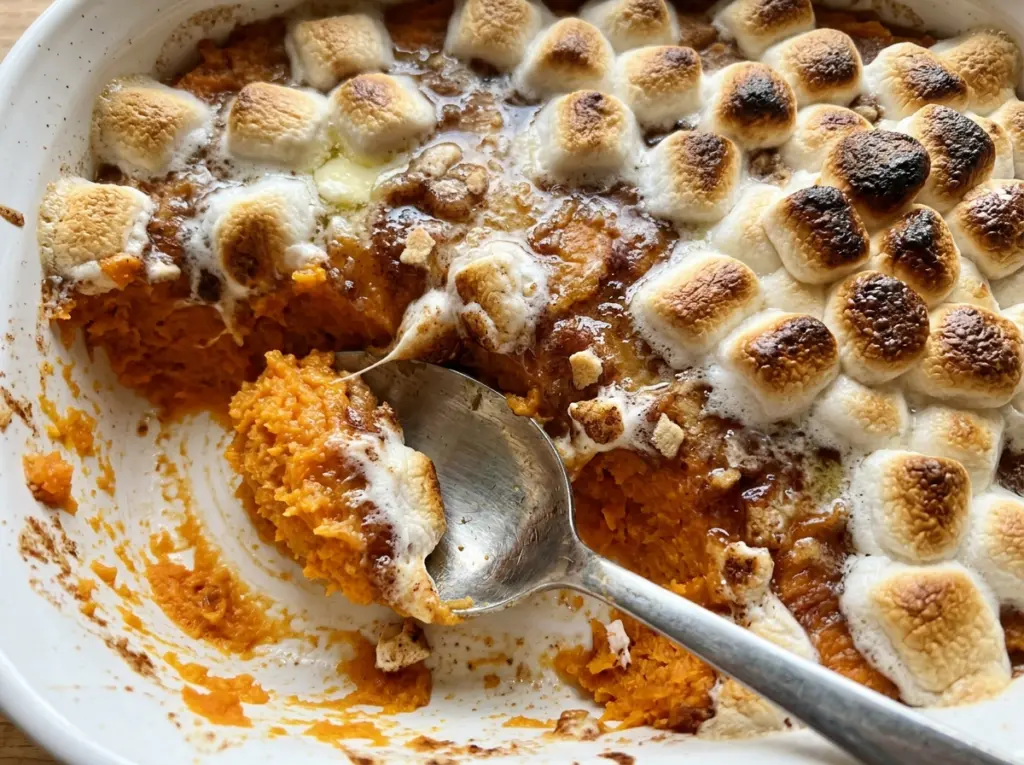
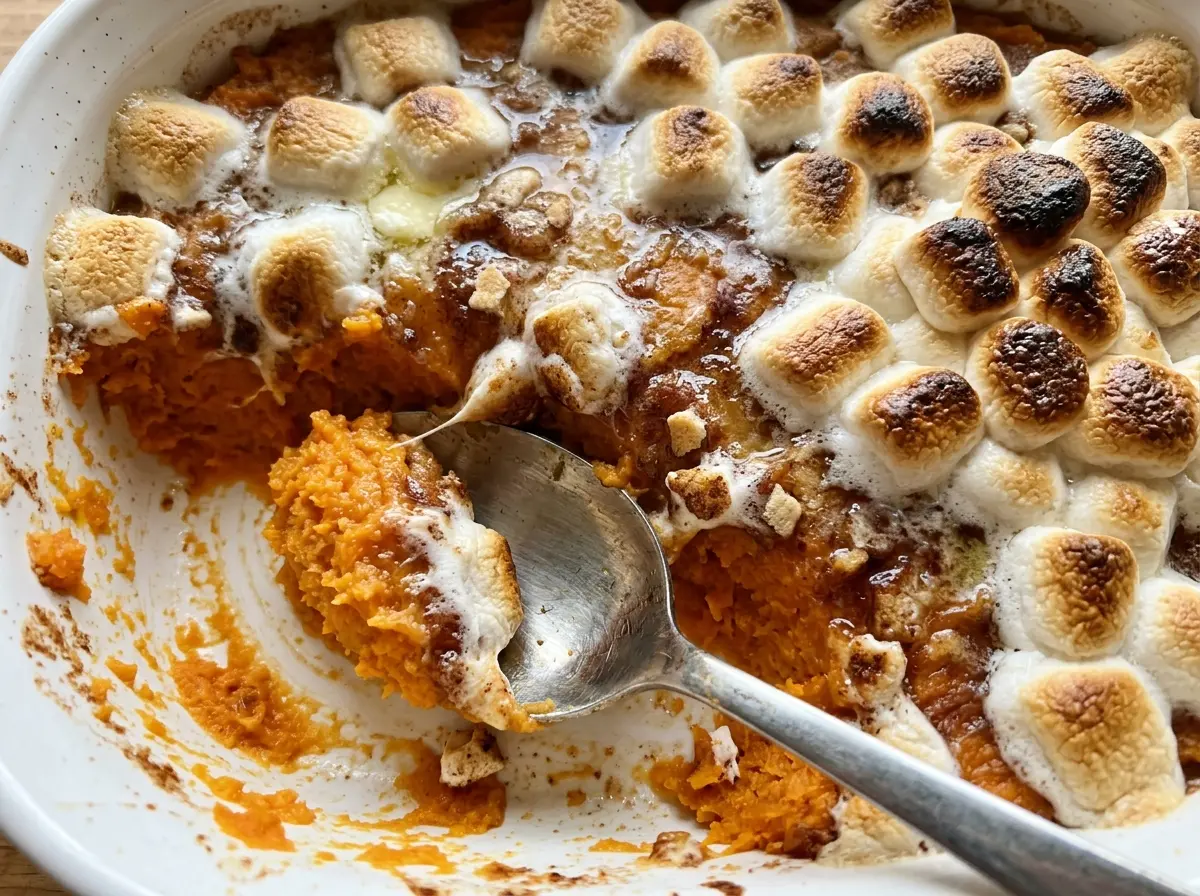
The sweet potatoes should mash into a soft, warm base, while the pecan topping stays crumbly enough to scatter over the top. That contrast is what I want from a baked sweet potato casserole: a tender filling with a browned, buttery finish, not a heavy layer that disappears into the mash.
I boil the potatoes until a fork slides through easily, then mash them with melted butter, brown sugar, milk, eggs, vanilla, and salt. The eggs help the filling set as it bakes, while leaving the potatoes mostly smooth gives it a little more body than a completely uniform puree.
The topping comes together in a separate bowl, so it stays distinct from the filling as it bakes. Spread everything in a 9×13-inch dish, bake until the center reaches 160°F and the pecans are golden, then let the casserole rest before serving. Each spoonful has soft sweet potato underneath and a buttery pecan crunch on top.
Kitchen Note
Stop mixing the topping when it looks like loose, damp crumbs. If you keep stirring until it turns into a paste, it won’t scatter over the filling as evenly.
Save this Sweet Potato Casserole for its tender brown-sugar filling and golden pecan crumble.
Why the Brown Sugar Is Split Between the Filling and the Pecan Crumble
There are two different jobs for the brown sugar here, so I divide it instead of mixing all of it into the potatoes. The portion in the filling sweetens the mash itself, where it melts in with the butter and milk. The portion in the topping works with the flour, pecans, and butter to make the crumbly layer that browns in the oven.
That division keeps the topping from tasting like an afterthought. Each bite gets sweetness through the soft filling and a more concentrated brown-sugar note from the pecan crumbs. It also means the topping stays a separate layer rather than blending into the potatoes as you spread it around. When you assemble the dish, scatter the crumbs over the surface instead of pressing them down; an even, loose layer browns more consistently than a packed one.
The balance is intentionally straightforward: the potatoes remain the main flavor, with vanilla in the filling and pecans bringing a nutty finish. Since the sugar is already divided between two parts, keep each portion in its place when mixing. It makes the difference between a sweet potato base with a crisp-looking top and a casserole that tastes uniformly sugary.
What the Sweet Potatoes, Eggs, and Pecans Each Bring

- Sweet potatoes — Choose firm potatoes without soft spots. Fresh potatoes are the right fit for this method because they cook in water and mash into the filling; canned sweet potatoes have a different moisture level and may already be sweetened. Peel them and cut them into even cubes so they cook at a similar pace.
- Eggs — The lightly beaten eggs help the filling hold together once baked, giving it more structure than mashed sweet potatoes alone. They belong in the mash, not in the crumb topping. Keep them lightly beaten so they combine easily with the potatoes.
- Unsalted butter — Butter brings richness to both the filling and the pecan topping, but the two portions have separate roles. Unsalted butter also lets the kosher salt season the filling without making the topping taste overly salty. Melt the butter before dividing it between the two mixtures.
- Light brown sugar — Its soft, molasses-like sweetness suits the sweet potato filling and adds a deeper note to the topping. Packed brown sugar measures consistently, which matters when dividing it between both layers.
- Pecans and flour — Coarsely chopped pecans give the topping its distinct nutty crunch, while all-purpose flour helps the butter and sugar form crumbs around them. Fresh-tasting pecans matter most here because they sit right on top; the flour can be a standard pantry bag. Keep the pieces coarse rather than grinding them fine.
- Whole milk and vanilla — Whole milk loosens the mash and makes it creamy, while vanilla rounds out the sweetness. Use plain whole milk for the texture this filling is built around; the dairy-free option below swaps it for unsweetened oat milk.
From Fork-Tender Potatoes to a Golden Pecan Top
Get the oven and dish ready
Heat the oven to 350°F and grease a 9×13-inch baking dish before you start the filling. The dish gives the potatoes room to spread in an even layer with plenty of surface area for the crumble. Set out a 6-quart pot for the potatoes and a medium bowl for the topping. Having the baking dish ready makes it easier to move from mashing to assembling.
Boil the potatoes until a fork slides through
Put the peeled, 1-inch sweet potato cubes in the pot with the water and bring it to a boil over high heat. Lower the heat and simmer for 15 to 20 minutes, until a fork goes through the cubes without resistance. If the centers still feel firm, give them more time rather than mashing them early; firm pieces leave lumps in the filling. Drain the potatoes well before returning them to the pot.
Mash the filling while the potatoes are warm
Return the drained potatoes to the pot and mash them with half of the melted butter, one portion of the brown sugar, the milk, lightly beaten eggs, vanilla, and salt. Work until the mixture is mostly smooth, with no large chunks left, but don’t keep going after it reaches that texture. The filling should look creamy and hold together on the masher. If you overwork it into a completely uniform puree, you lose the pleasant, homemade body of a mashed-potato filling.
Make the pecan crumbs and bake
Stir the flour and coarsely chopped pecans together in a medium bowl, then mix in the remaining brown sugar and melted butter until crumbly. Spread the filling in the prepared dish and scatter the topping evenly across it without packing it down. Bake for 30 to 35 minutes, until the pecans are golden and the center reaches 160°F. Let the casserole rest for 10 minutes before serving so the filling has time to settle.
Three Practical Ways to Adapt the Sweet Potato Casserole
Make it dairy-free with oat milk and plant butter
Replace the whole milk with the same amount of unsweetened oat milk, and use the same amount of unsalted dairy-free plant butter in both the filling and topping. The casserole keeps its creamy texture, though the butter flavor will be less pronounced. The eggs remain part of the filling.
Use a gluten-free flour blend in the crumble
Swap the all-purpose flour for the same amount of a 1:1 gluten-free baking flour blend. Keep the pecans, brown sugar, and butter unchanged. The topping may have a slightly different crumb, but it still forms a scatterable layer over the filling.
Trade pecans for walnuts
Use the same amount of coarsely chopped walnuts in place of the pecans. The topping keeps its crunchy texture, with a slightly earthier, less buttery-nut flavor. Chop them to a similar size so they distribute evenly through the crumbs.
Storage and Reheating
- Refrigerator: Cover leftovers and refrigerate for 3 to 4 days. The pecan topping softens as it sits, while the filling stays tender.
- Freezer: Freeze the cooled casserole in an airtight, freezer-safe container for up to 2 to 3 months. Thaw it in the refrigerator overnight; the topping will be softer after thawing.
- Reheating: Warm covered in a 350°F oven until heated through, with the center reaching 165°F. Leaving it uncovered the whole time can dry the filling before the middle is hot.
Questions That Come Up When Making Sweet Potato Casserole
Sweet Potato Casserole
Ingredients
Equipment
Method
- Heat the oven to 350°F.
- Grease a 9x13-inch baking dish.
- Put the sweet potatoes and water in a 6-quart pot.
- Bring to a boil over high heat.
- Simmer until the potatoes are fork-tender, 15 to 20 minutes.
- Drain the potatoes well.
- Return the potatoes to the pot and mash with 1/2 cup of the melted butter, 1/3 cup of the brown sugar, the milk, eggs, vanilla, and salt until mostly smooth.
- Stir the flour and pecans together in a medium bowl.
- Mix in the remaining 1/3 cup brown sugar and 1/4 cup melted butter until crumbly.
- Spread the filling in the prepared dish.
- Scatter the topping evenly over it.
- Bake until the topping is golden and the center reaches 160°F, 30 to 35 minutes.
- Rest for 10 minutes before serving.